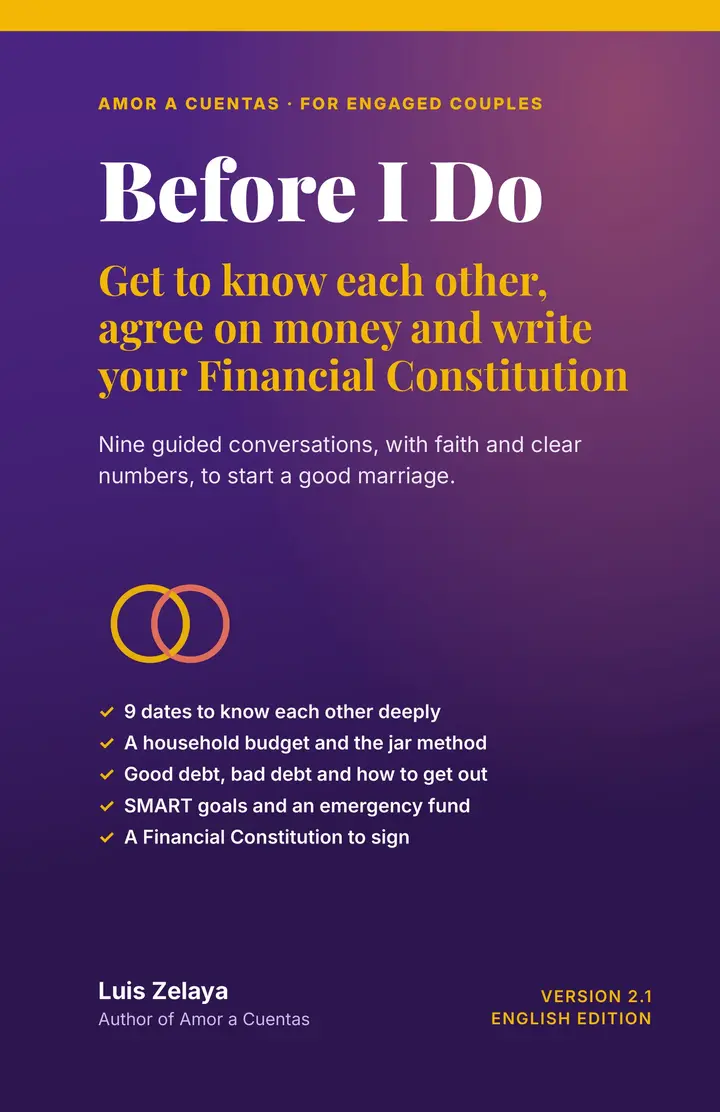
Premarital book for engaged couples · full-color paperback on Amazon
Before I Do: the premarital money book to get to know each other, agree on money and write your Financial Constitution
Nine guided conversations, with faith and clear numbers, to start a good marriage: your stories, your faith, children, family, the budget, debt and your dreams. At the end you write and sign your Financial Constitution together.
Printed in full color and shipped by Amazon. · Edición en español: Antes del Sí
Money conversations before marriage: why talk about everything before “I do”
Money is rarely just money. It carries security, freedom, faith, the family you come from and the one you want to build. That’s why this book doesn’t start with numbers: it starts with getting to know each other.

- 40% of people living with a partner in the United States have hidden something about money from their partner, and 23% have hidden a debt (Bankrate/YouGov survey of 2,217 adults, December 2024).
- 53% of newlyweds argued about money before or after the wedding (LendingTree survey of 1,050 newlyweds, March 2025).
What matters most isn’t how much you have, but how you talk about it.
8 premarital questions to ask each other
A sample of what you’ll talk about. In the book, every question sits inside a guided date, with its order, its timing and the agreement you leave with.
- Who handled the money in your home growing up, and how were decisions made?
- What does each of us think about tithing, offerings and giving?
- Do we want children? How many, and roughly when?
- How much do you earn, how much have you saved and how much do you owe, in exact numbers?
- Will we have joint accounts, separate accounts or both?
- Which of our debts are good and which are bad?
- What is our emergency fund target, and where will we keep it?
- Do we rent or buy? When, where and with what maximum monthly payment?
What to talk about before marriage: the 9 dates
Each date takes 60 to 90 minutes. You leave every one with a written agreement, and in the last one you bring them together in your Financial Constitution.

Part 1Getting to know each other
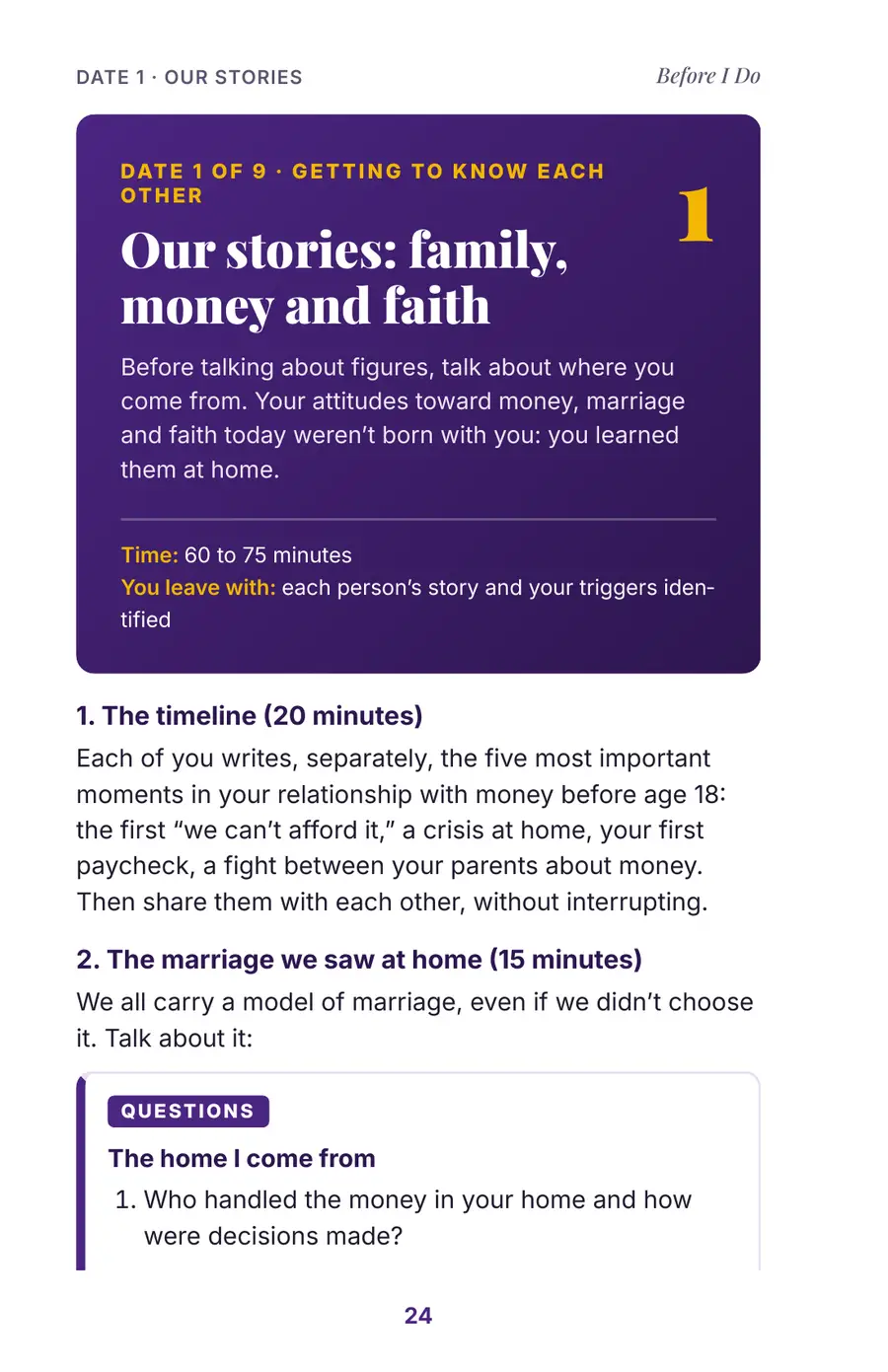
Date 1 · Our stories: family, money and faith
Where each of you learned to see money, marriage and faith: your money timeline and the home you come from.
Date 2 · What we believe and what we expect
Your money values, how you will live your faith in practical terms (tithing, offerings and giving) and how you will share household chores.
Date 3 · The family we will build
Children, extended family, careers and where to live: the topics that change a budget the most.
Date 4 · Our dreams
Your dreams across 4 horizons (3 months, 1, 5 and 20 years) and the why behind each one.
Part 2Household finances
Date 5 · Cards on the table
Income, savings, debt and credit with exact numbers, and one rule: what is said today is never used as a weapon tomorrow.
Date 6 · Our system
Joint, separate or hybrid accounts, how much each of you contributes if one earns more, your budget and your jars.
Date 7 · Debt, cushion and goals
Your plan to get out of bad debt, your emergency fund target and your first SMART goals.
Date 8 · Protection and the first years
How to look after each other (insurance, beneficiaries, a will) and the big changes: housing and children.
Part 3Your Financial Constitution
Date 9 · Write and sign the Constitution
You bring all your agreements into one document, decide how you will settle disagreements and sign it together.
What’s inside the book
Full-color paperback
A printed book to keep on the table and write in together, worksheets included.
9 guided dates
Each one with how long it takes, what to bring, questions to talk through and the agreement you leave with.
How to talk about money without fighting
Before the numbers: how to talk with honesty and without blame.
The married household budget
A 9-step method with examples in US dollars that you can adapt to your own currency.
Jars and the envelope system
Eight jars so every dollar has a purpose, including a giving and tithe jar.
Good debt and bad debt
5 questions to ask before signing any debt, assets before liabilities, and how to get out of bad debt as a team.
Emergency fund and SMART goals
The steps of an emergency fund and how to turn your dreams into goals with a number and a date.
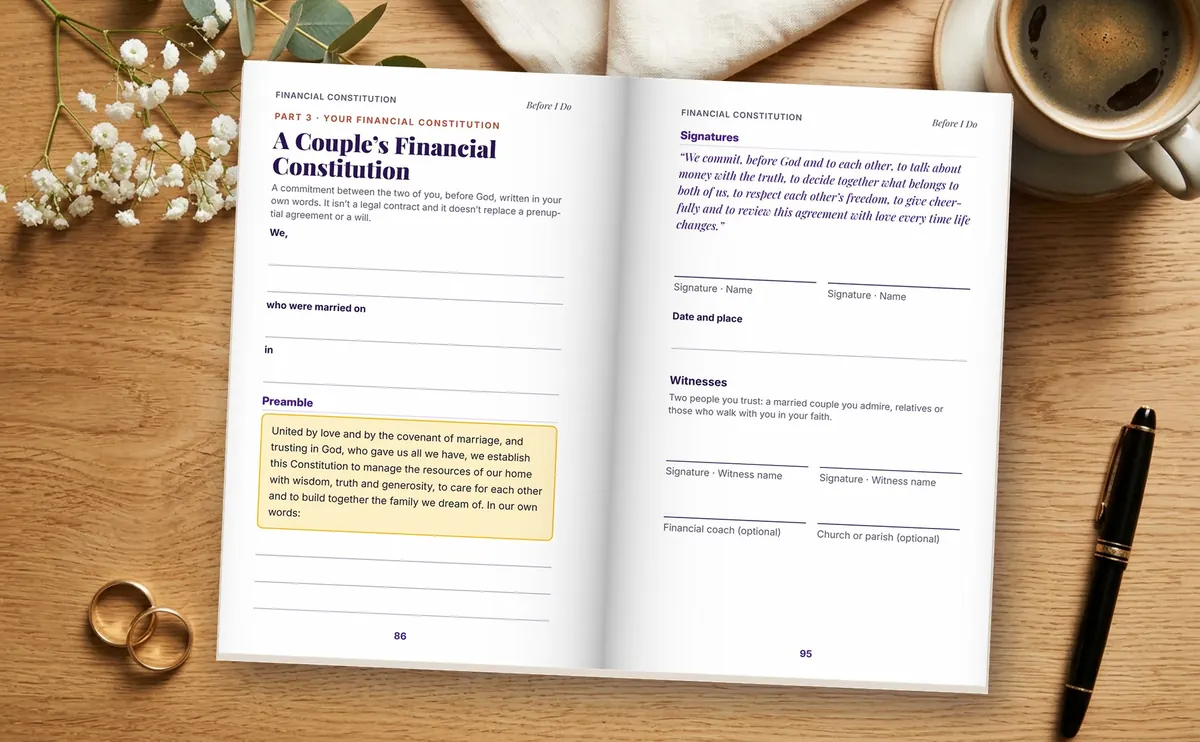
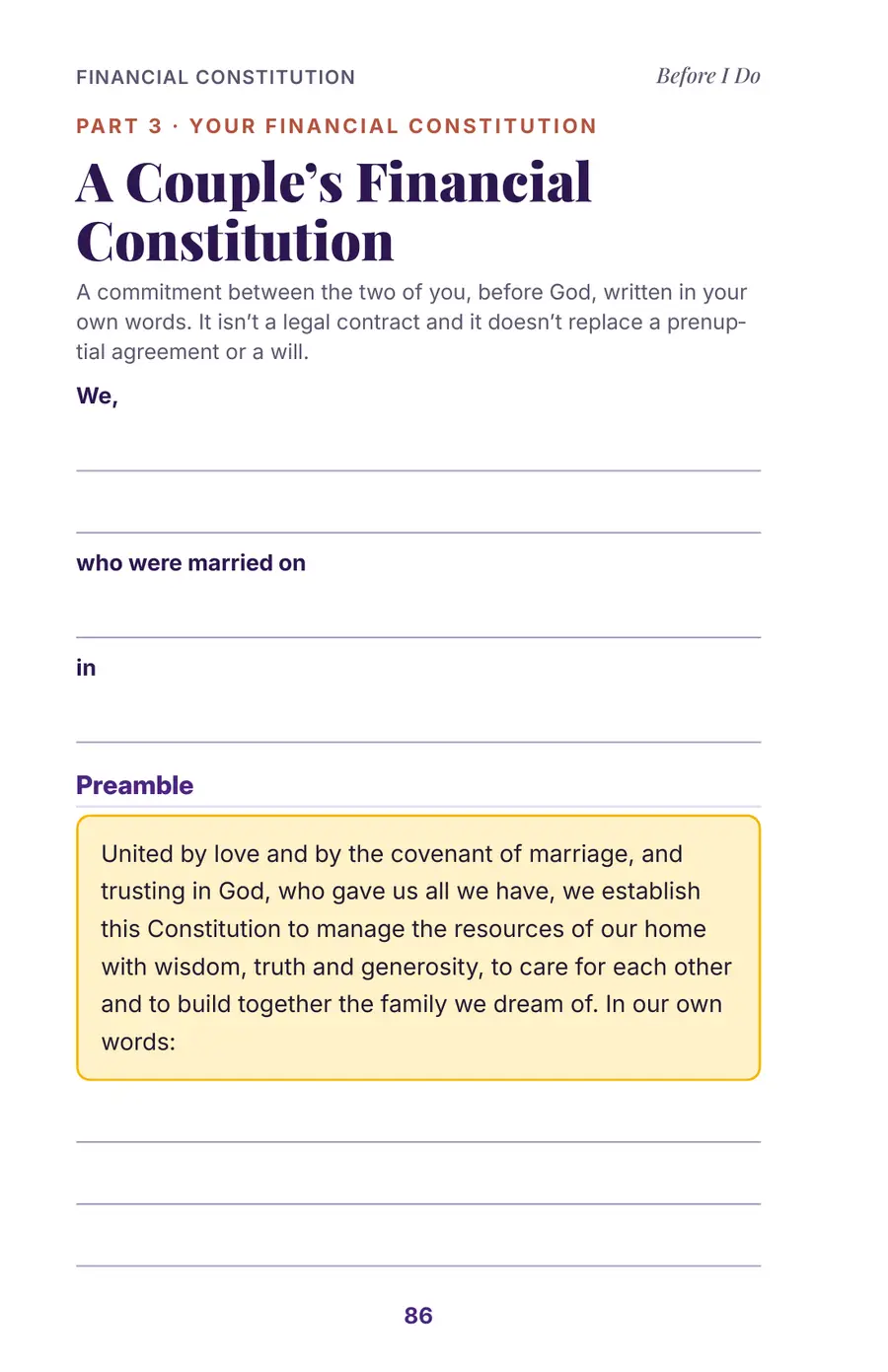
A Couple’s Financial Constitution
A document to sign, with a preamble, principles and articles written in your own words.
Your plan for the first 12 months
The weekly, monthly and yearly habits that keep the system working once you are married.
Case study and worksheets
A fictional example from start to finish and 7 worksheets: inventory, budget, jars, debt, goals, horizons and a debt-free wedding.
A couple’s money glossary
The money terms used in the book, explained in plain words.
Look inside
Inside the book
The contents, a guided date, and a worksheet.
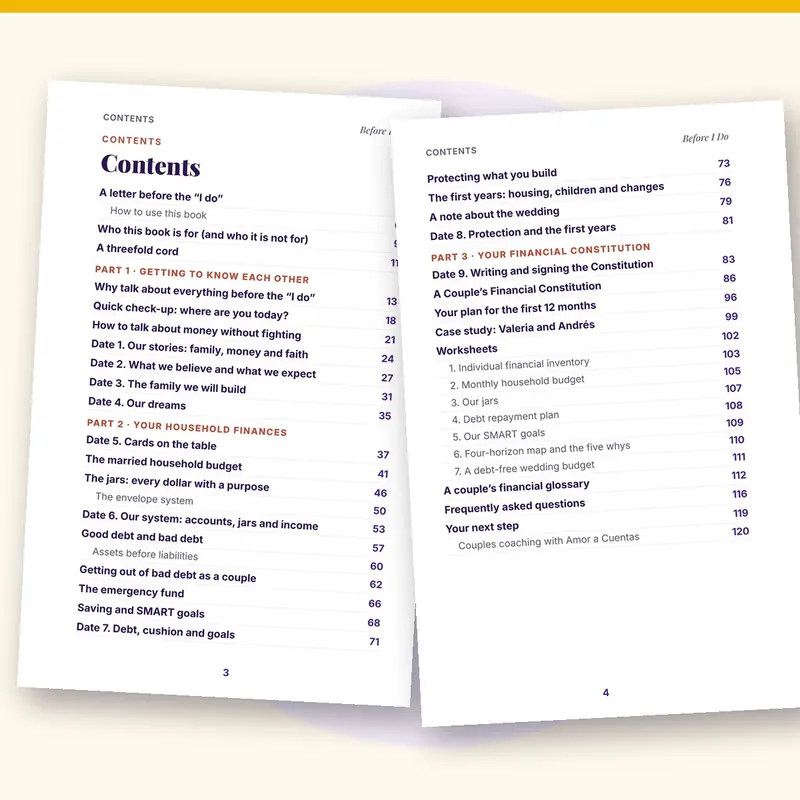
Nine dates in three parts
Getting to know each other (stories, faith, family, and dreams), household finances (numbers, budget, debt, and protection), and your Financial Constitution.
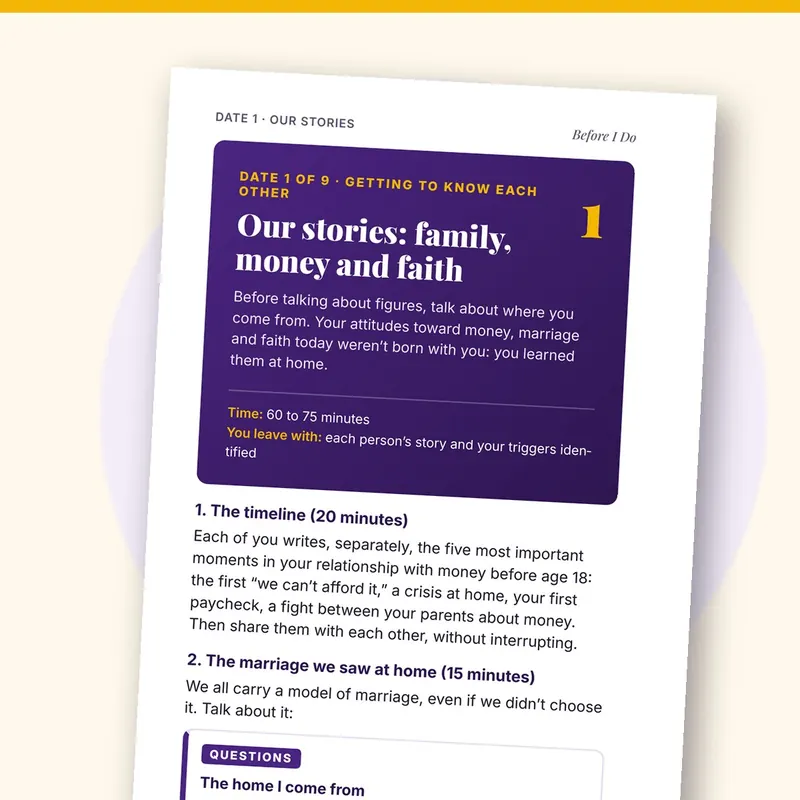
Talk about money without fighting
Every date includes a time guide, questions to answer together, and words to say the hard things with honesty and without blame.
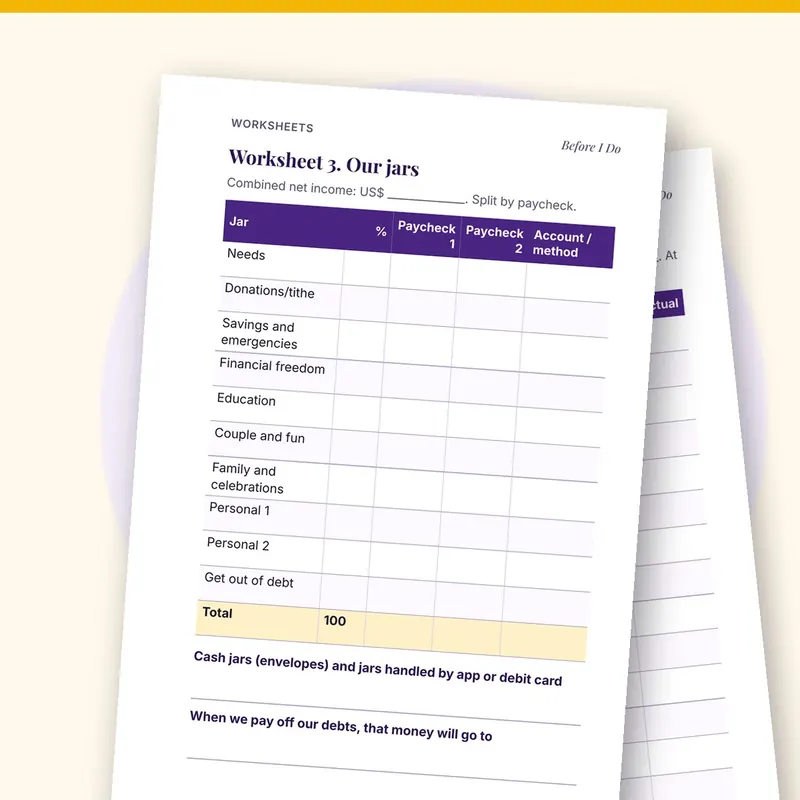
Worksheets to fill in together
Seven worksheets: financial inventory, household budget, jars, debt plan, SMART goals, dreams, and a debt-free wedding budget.
Two pages from the book: the start of Date 1 and the Couple’s Financial Constitution.
The money topics engaged couples worry about most
Marriage: joint or separate accounts?
The three models with the same example in dollars, and what to do when one of you earns more.
Good debt and bad debt
Five questions to ask before signing any debt, and a plan to get out of the bad kind as a team.
A married budget and jars
Your household budget step by step and eight jars so every dollar has a purpose.
A wedding without debt
A worksheet to set your wedding cap without credit cards or loans: the party lasts one night; the debt can last for years.
Who it’s for
- Engaged couples, couples planning to marry in the coming months, and newlyweds.
- Couples who want to know each other deeply: history, faith, expectations, children, family and goals.
- Anyone who has never talked about money with exact numbers, or tried and ended up fighting.
- Couples who don’t know how to build a married budget or whether to have joint or separate accounts.
- Couples where one or both partners bring debt or support their families financially.
- Those who want their faith to show in how they run their home’s money.

An engagement gift they’ll actually use
For engaged or newly married couples, and for those who want their faith to show in how they run their home.
It also works as a guide for pastors, mentors, and married couples who lead premarital counseling: every date is ready to use with one couple or a small group.
It’s not for you if you are looking for legal advice on prenuptial agreements, inheritance or divorce, or an investing course.
Before I Do: Get to Know Each Other, Agree on Money and Write Your Financial Constitution
Full-color paperback
Sold on Amazon · printed in full color, made to write in together · shipped by Amazon
Edición en español: Antes del Sí

Who wrote it
Luis Zelaya
Author of Before I Do (Antes del Sí) and Del Pleito al Plan · Creator of Amor a Cuentas
In the book he shares stories from his own family and experience: the non-negotiable month-end close, his grandfather’s seed and his father’s envelopes.
Frequently asked questions
What is “Before I Do”?
A Christ-centered premarital book for engaged couples, as a full-color paperback on Amazon. Over 9 guided dates you get to know each other deeply, put your numbers on the table, build your household budget and jars, decide your plan for debt, an emergency fund and goals, and at the end you write and sign your couple’s Financial Constitution.
How do I get it?
Buy the full-color paperback on Amazon, which Amazon ships to you.
Is it available in Spanish?
Yes. The original Spanish edition is “Antes del Sí,” also on Amazon in paperback.
Will my partner’s debt become mine when we marry?
It depends on the law where you live and the marital property rules that apply to you, so talk to a family lawyer. In practical terms, one person’s debt does affect both of your budget and goals, and Dates 5 and 7 help you put it on the table and build a plan.
Joint or separate accounts?
There is no single model. A hybrid works for many couples: one joint account for shared costs and a personal account for each of you. What matters is that it is a written agreement. Date 6 compares the models with the same example in dollars.
Is the Financial Constitution a legal document?
No. It is a commitment between the two of you, before God, written in your own words. It is not a legal contract and does not replace a prenuptial agreement or a will. For those, talk to a lawyer where you live.
Is it only for Christian couples?
It is written for Christian couples, Protestant or Catholic, and for any couple who wants to build their home on shared values. It stays away from topics that divide one church from another.
Does it work if we are already married?
Yes. The nine dates work the same after the wedding. The book suggests starting with Dates 5 and 6 and writing your Constitution in your first month.
Free reading for engaged couples
- 30 Money Questions to Ask Before Marriage: What to Talk About Before You Say “I Do”
- Joint or Separate Bank Accounts After Marriage? The 3 Options and How to Choose
- If I Get Married, Do I Take On My Partner’s Debt? What to Clear Up First
- Simple Wedding Budget: How to Plan Your Wedding Without Going Into Debt
- Fighting About Money in Marriage: How to Prevent It While You’re Still Engaged
- Premarital Counseling: 8 Topics You Can’t Skip (and How to Prepare at Home)
Disclaimer
Educational content, not financial, legal or psychological advice. The Couple’s Financial Constitution is a commitment between the two of you, not a legal contract, and it does not replace a prenuptial agreement or a will. Rules on marital property and debt depend on the law where you live: talk to a lawyer there. What the book says about insurance is general: coverage and premiums are set by the insurer; talk to a licensed agent or broker. The statistics quoted come from surveys published in the United States, and the numerical examples are illustrative and in US dollars.